

Rahman Sajjadi
Rahman Sajjadi
In this converter, it was tried to adjust and control the DC link voltage of the inverter, which was in the form of a capacitor, in unequal values by using low frequency SHE modulation, so that the output waveform of the inverter has less distortion. Also, at the same time, the reactive power required by the network is also provided through the inverter so that the network voltage remains constant. In this system, the efficiency of the converter has been improved by using low frequency modulation. Practical tests have been done in three phases with two cells in each phase.
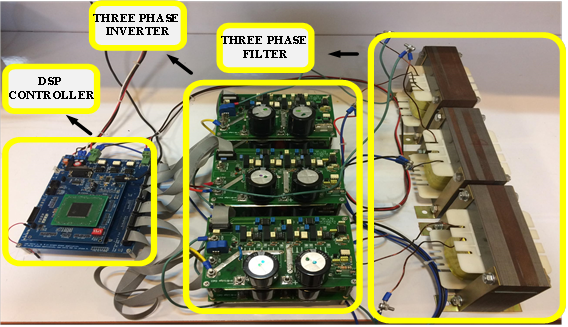
Armin Mir Emad – Kourosh Khalaj Monfred
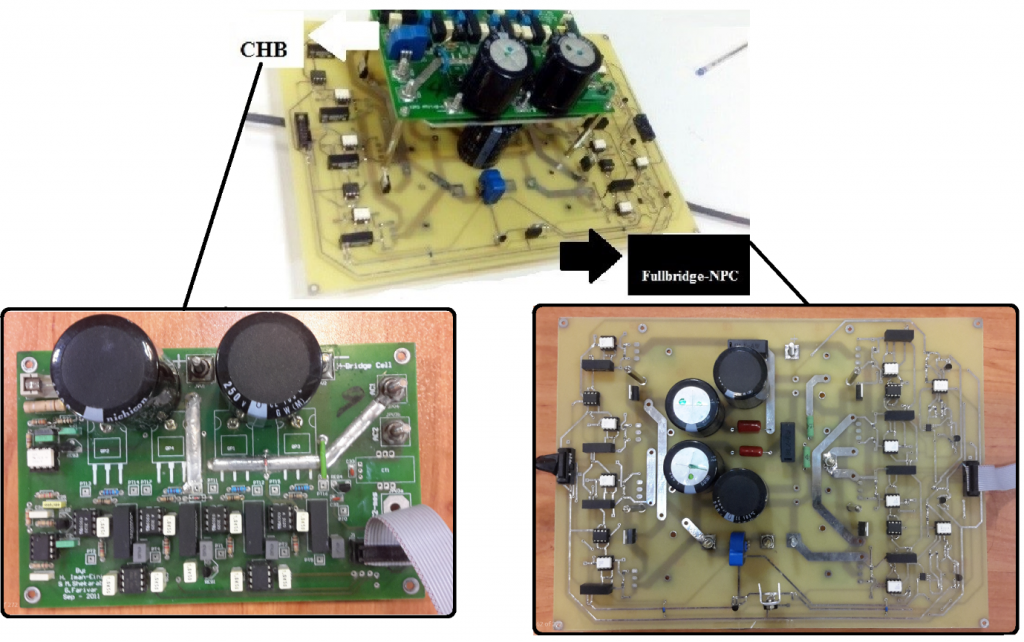
The hybrid converter is made from the combination of the series of full-bridge diode inhibition converter with the H-bridge converter. The main advantage of the hybrid converter is to make the number of levels equal to the number of keys compared to other multi-level basic arrangements.
Converter applications:
Power Quality
Drive
Massoud Shahab Aldini
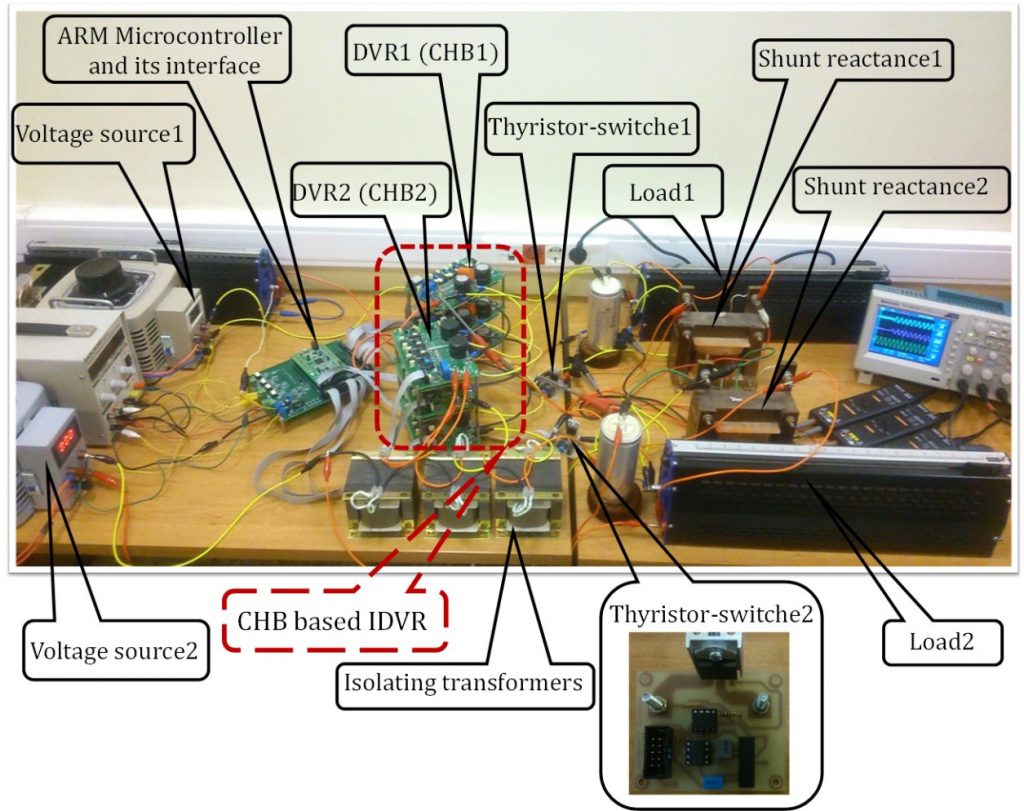
Because the voltage compensation process may be accompanied by active power injection, the ability of a compensator, especially to compensate for voltage shortages with greater depth and for a longer period of time, depends on the amount of energy stored in its DC link. To solve this problem, you can use a number of compensators that are connected to different feeders, while all these compensators have a common DC link. This structure of compensators is called inter-line voltage dynamic compensator. The inter-line voltage dynamic compensator has the ability to transfer active and reactive power between independent feeders through a common DC link and thus help to compensate for the lack of larger voltages.
applications:
Voltage compensation and increase in power quality
Alireza Bagheri
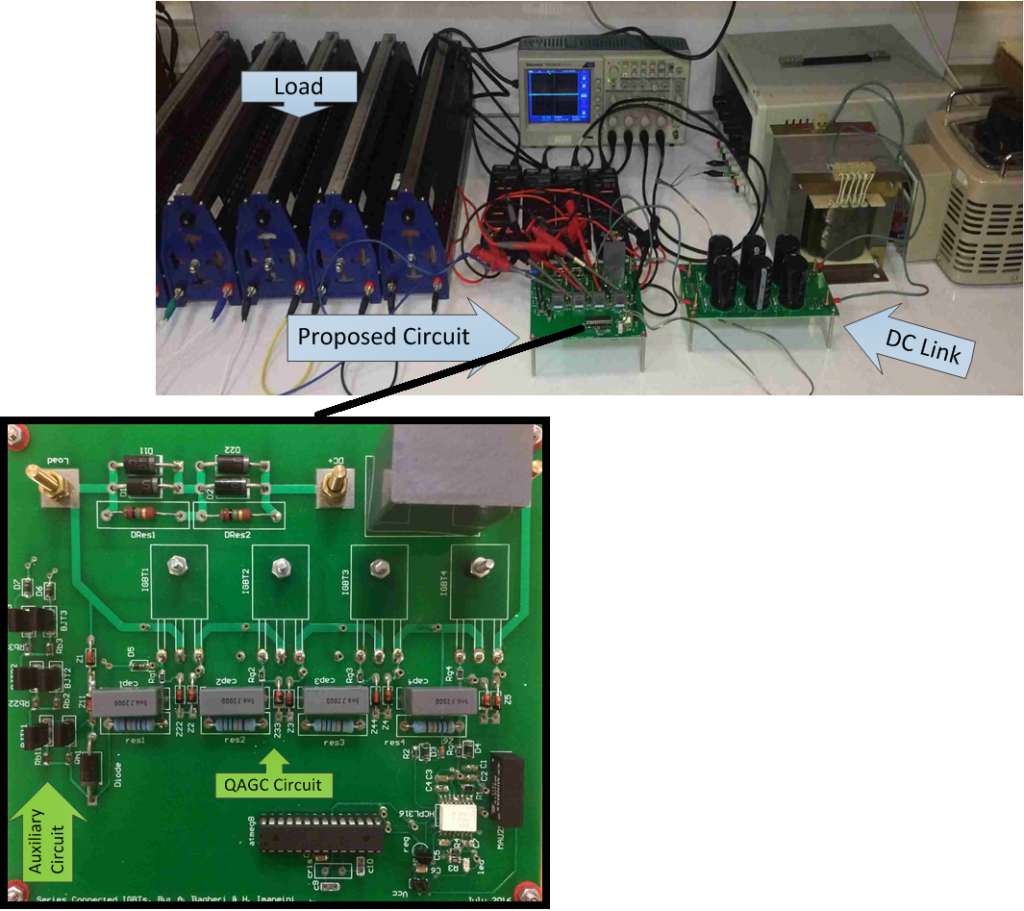
In recent years, the significant growth of high voltage applications in the energy conversion industry has revealed the importance and need for high voltage and high power electronic converters. Semiconductor switches are one of the important components of electronic power converters. Therefore, the first and most important issue in high voltage power electronic converters is the limitation of voltage tolerance of semi-conductor switches. One of the ways to overcome the mentioned limitation is to series IGBT switches to make a high voltage semiconductor switch. In the method of serialization of keys, balancing the voltage of the keys is an important matter, the failure of which makes this method ineffective. In this project, a simple and modified circuit based on the quasi-active gate control method (QAGC) is proposed, which is capable of serializing the desired number of IGBT switches and statically and dynamically balancing the voltage in them. One of the most important advantages of this circuit is the use of only one gate pulse to turn on or off the set of serial keys. In other words, this circuit works like a high voltage semiconductor switch. Simplicity, reliability, small number of circuit components, cheap price and small volume are among the features considered in the proposed method. The proposed circuit is presented in the form of two separate arrangements, which are: sequential arrangement and local arrangement. The optimal voltage balancing in eight series IGBT switches by the proposed circuit has been confirmed in the simulation results. Also, the accuracy of the results obtained in serialization of four IGBT switches using the proposed method has been confirmed in the laboratory implementation.
applications:
All high voltage devices in power electronics
Alireza Hadizadeh, Masoud Noushek
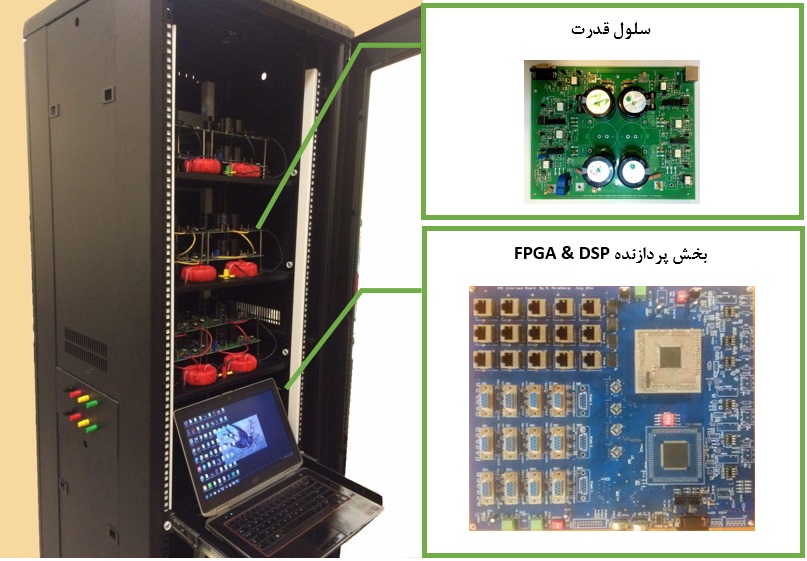
One of the structures of multilevel converters that has the ability to perform well in high power applications is the three-phase modular multilevel converter (MMC). This structure ensures reliable performance and facilitates system maintenance and troubleshooting, and due to its modular structure, it can be easily expanded and upgraded. Especially in the event of a fault, the modular structure allows the system to locate the fault. isolate it and take it to a safe state and in many cases it provides the ability to continue working in faulty conditions. In this regard, the converter will have less dangerous consequences for the converter and the system by dividing the energy among several cells. By using this multi-level structure, the optimal harmonic performance of the output is guaranteed, and practically the network filters are negligible, which leads to a reduction in the cost and complexity of the system. On the other hand, not needing independent DC sources and using a DC source adds to the simplicity of this system.
The challenges facing this converter are balancing the voltage of the capacitors of each cell, reducing the circulating current, issues related to the error and the launch issue in this structure, which can be solved by providing a suitable control method.
applications:
High power applications, especially HVDC lines and topics related to electric motor drives
Mohsen Kamali Rad
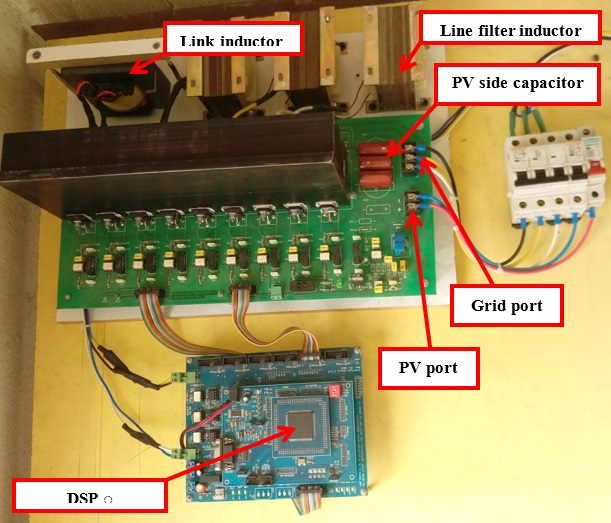
In this project, the inverting buck-boost DC/DC converter forms the basis of the proposed inverter developed for three-phase application. Also, a new keying method is used in it. The general method in this inverter is that by receiving the size and phase of the voltage of the three phases of the network and according to the amount of power intended to be injected into the network, the size and phase of the injected current is obtained. The inverter is keyed in such a way that the desired current is programmed at the output of the inverter.
By choosing a suitable topology and a new switching method, it is possible to inject power from a DC source with a voltage lower or higher than the grid voltage. Not using an electrolytic type capacitor in this inverter has increased reliability, and also by using an inductor to transfer power, soft switching conditions have been provided in many switching situations. Also, by using the switching method and topology used in this inverter, there is no leakage current.
Youssef Nishaburi
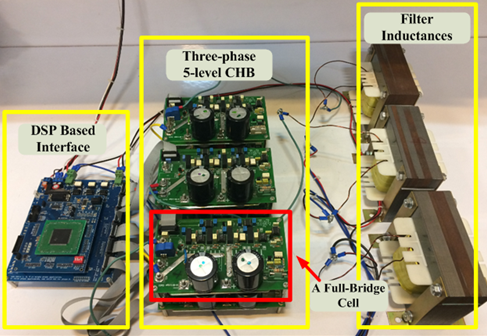
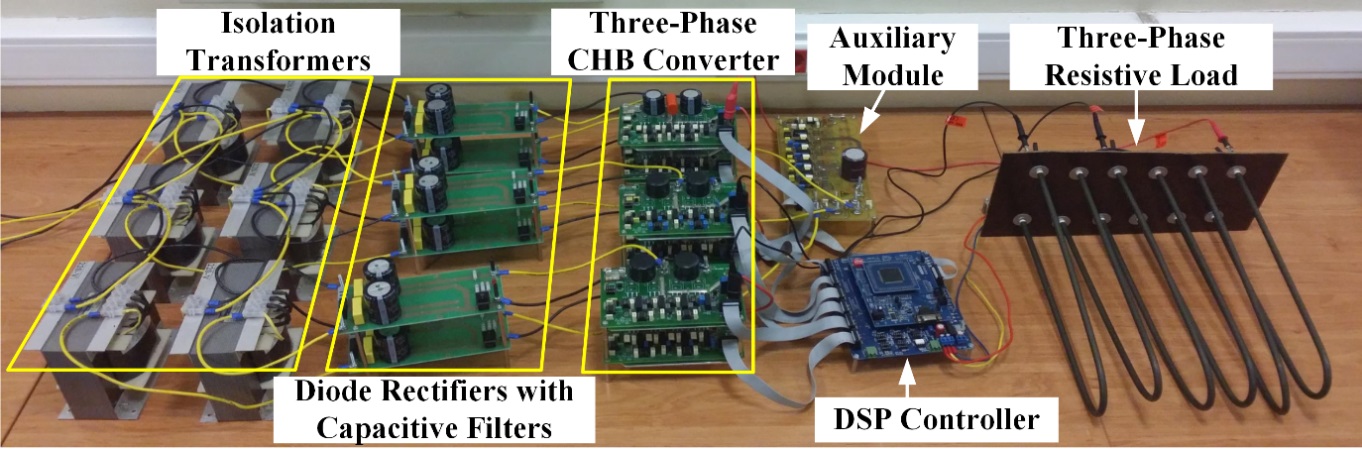
The parallel compensator of the series bridge, whose three-phase, five-level laboratory sample can be seen in the picture, improves the power factor, power transmission capacity and voltage stability by injecting reactive power into the network.
In the following experimental example, first of all, the closed loop control system of the parallel compensator is implemented by the DSP controller, which, in addition to controlling the injection of reactive power into the network, also absorbs the active power required to keep the voltage of the capacitors charged from the network. And it also distributes the power among the cells in such a way that the voltage balance of their capacitors is provided. In the next step, the performance of the compensator under the conditions of the occurrence of errors in its semiconductor switches was studied and the error-resistant control method was implemented in it. This method guarantees the continuity of the operation of the parallel bridge compensator after the occurrence of an error in its semiconductor switches.
applications:
Parallel compensator, increasing power quality, fault tolerance
Abbas Kiyani Harchgani
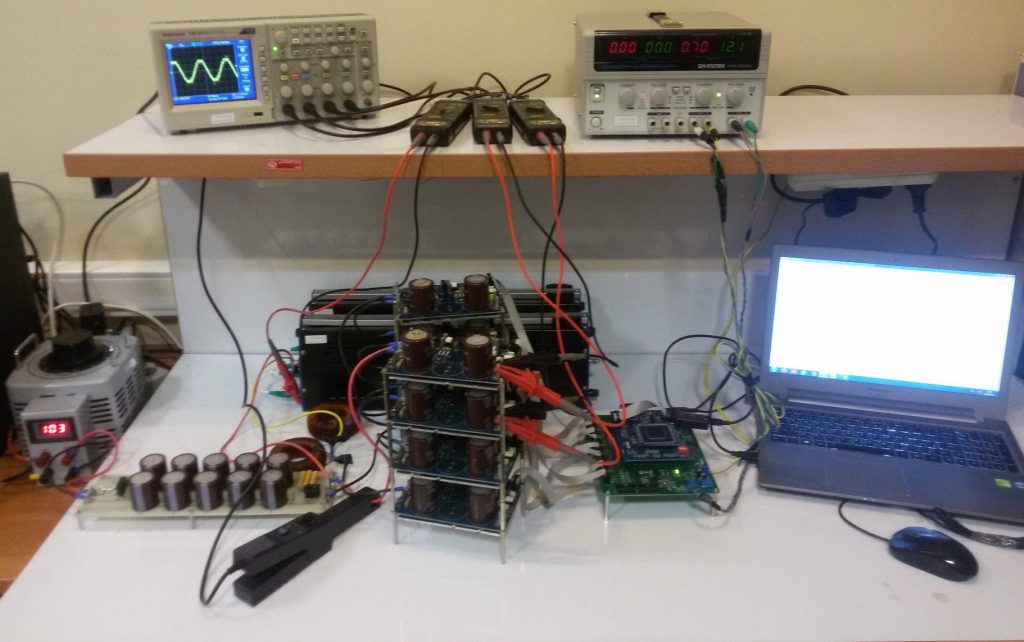
The modular multilevel converter, MMC, has been welcomed by engineers and researchers in the last few years due to its special features and unique advantages over other multilevel converters, and currently a lot of research is being done in this field. This converter is especially important for converting dc to ac voltage or vice versa at high voltage levels. Balancing, controlling and reducing the voltage ripple in this converter is a fundamental challenge so that its correct operation is not possible without realizing this importance. The figure below shows a sample of a single-phase converter with 4 cells in each leg, which was made in the power electronics and energy systems laboratory and to study in the field of control and other challenges of this type of converter.
Vahid Samavatian
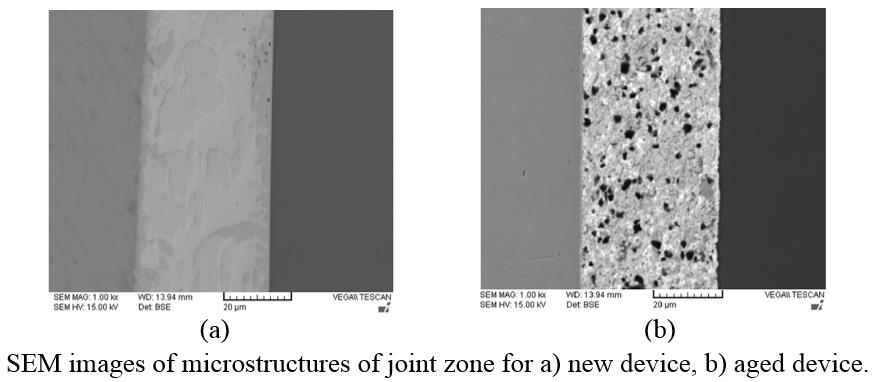
Continuous and reliable operation of electronic power converters plays a key role in all applications. Manufacturers’ concerns about the warranty period along with maintenance time and cost have made researchers eager to evaluate reliability with acceptable accuracy. Engineer Samavatian’s doctoral dissertation focuses on a new version of reliability assessment and the feasibility of using sensitivity analysis for more accurate estimation. This treatise deals with the step-up DC-DC converter as a case study in two common and separate thermal structures. This research shows that the mutual influence of elements can play a very important role in evaluating the reliability of a converter with a common thermal structure. It is shown that while the erosion of the IGBT and diode (see figure below) leads to an increase in their junction temperature, the electrical operating point of the converter remains unchanged even when the capacitor is eroded. This is while the separate thermal structure does not have much mutual influence on the parts either in the thermal working point or in the electrical working point. The results of this thesis reveal the importance of internal and mutual erosion in reliability evaluation.
Hoshang Salimian
Due to the large number of semiconductor switches used in multi-level converters, the possibility of errors occurring in them is higher. As a result, in order to ensure the continued operation of the converter and prevent the increase of damage, it is very important to detect and locate the fault, as well as the resistant performance of the converter against fault conditions. In this project, methods are proposed to detect the open circuit fault and the fault resistant operation of the series bridge converter.
The proposed method for fault detection and location compares the reference voltage commanded by the control system with the value of the output voltage of the converter phase in the time domain and detects the occurrence and location of the fault in the event of a fault. To measure the output voltage and current direction, one voltage sensor and one current sensor are used in each phase, which is the least number possible. In addition to producing the desired voltage at the output, this method guarantees the fault location in the shortest possible time, independent of the modulation method and the size of the modulation coefficient. The efficiency of this error detection method was confirmed in the simulation environment and on the laboratory sample.
Also, a method to continue the operation of the converter after the fault occurrence by producing the highest possible output voltage similar to the normal state was proposed. The proposed method adds an auxiliary module to the converter. The proposed method has a lower cost and equal or greater production power than similar methods by adding hardware. By implementing the method in the simulation environment and laboratory hardware, its accuracy and efficiency were confirmed.
Power Electronics and Energy Systems Laboratory was established in 2010 with the aim of training efficient engineers and researchers. In this educational and research environment, specialized fields such as the design of power electronic systems, including all types of power supplies, inverters and rectifiers, high and multi-level power converters, types of high voltage or HV systems, energy conversion systems, etc. are under study and research.

Design: Mahyan